The Lab
A public-safe map of the architecture, operating model, and design boundaries behind Packets & Regrets.
This is the stable overview behind the incident reports: enough architecture to explain the engineering, without publishing a reconnaissance pack disguised as documentation.
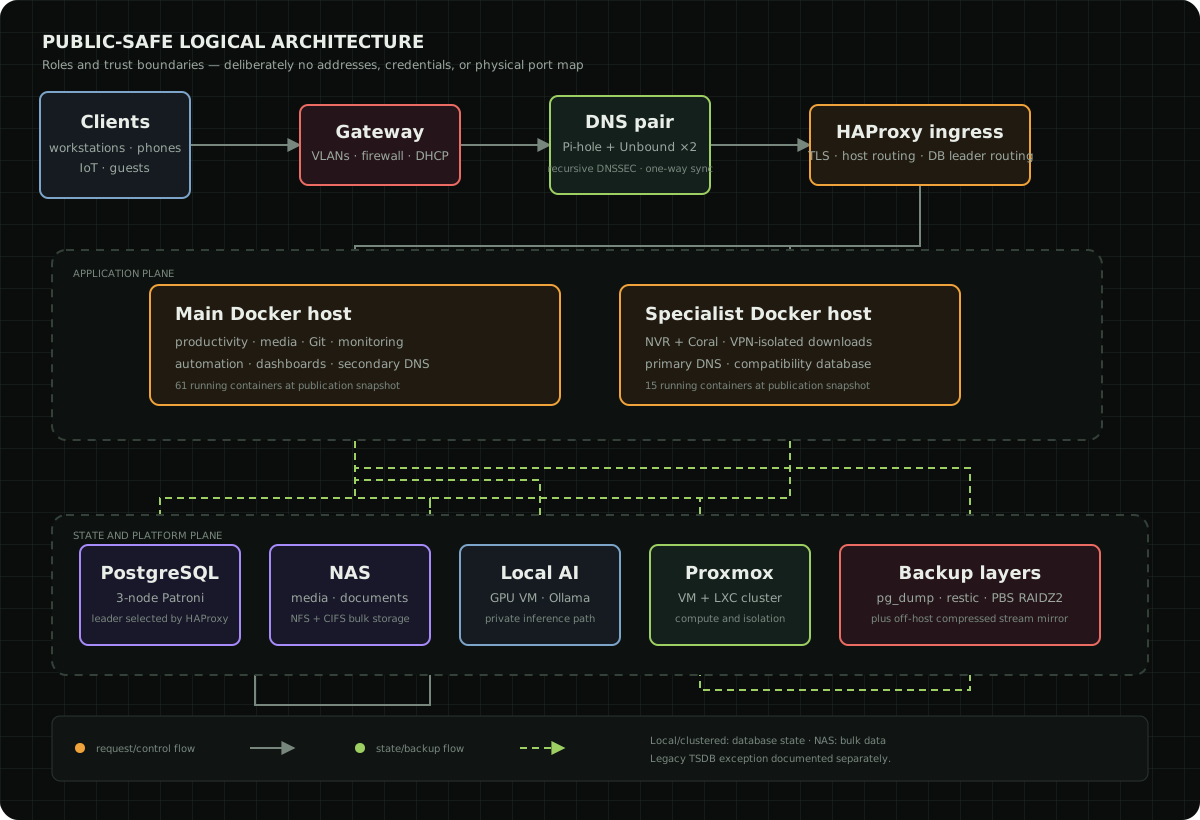
At a glance
| Layer | Current shape |
|---|---|
| Compute | Six Proxmox nodes running purpose-specific VMs and LXCs |
| Application runtime | Two Docker VMs, 76 running containers at the publication snapshot |
| Ingress | One HAProxy LXC for TLS and host-based routing |
| Databases | Three-node PostgreSQL/Patroni cluster, plus one compatibility PG14 instance |
| DNS | Two Pi-hole instances, each with its own recursive Unbound resolver |
| Storage | Local disks for databases and mutable app state; NAS for media and bulk documents |
| Backups | Nightly database dumps, restic, Proxmox Backup Server on RAIDZ2, and an off-host stream mirror |
| Private AI | Ollama on a GPU VM; selected document and alert workflows stay on the LAN |
The request path
Clients receive two DNS servers through DHCP. Both can answer local service names and both recurse independently through their own Unbound instance. One-way configuration synchronization keeps the secondary useful without pretending two mutable Pi-hole databases can magically merge.
Most web requests terminate TLS at HAProxy. It routes by hostname to a Docker service, VM, or LXC. Application containers therefore do not each need to become miniature certificate-management projects.
PostgreSQL clients also enter through HAProxy. Health checks identify the current writable Patroni leader, so applications do not need to know which database node currently owns that role.
The state path
The important boundary is not “container versus VM.” It is latency-sensitive state versus bulk data.
Databases and mutable application metadata belong on local filesystems or the PostgreSQL cluster. Media libraries, document originals, recordings, and backup repositories use the NAS. A legacy Prometheus TSDB-on-NFS decision violated that boundary and eventually corrupted its WAL; that incident has its own field note because architectural rules are more convincing after they invoice you.
The operational path
Compose configuration lives in Git, split into one fragment per service. Each Docker host keeps a repository clone and synchronizes its host-specific tree into a separate live directory. A SOPS-aware deployment wrapper decrypts secrets into a real temporary dotenv file, deploys, verifies, and removes plaintext afterward.
Changes are applied and verified against the running system before being committed. That is not pure reconciliation-driven GitOps. It is intentionally boring Git-backed operations with a small blast radius and an audit trail.
The failure boundaries
- The two DNS paths fail independently.
- The reverse proxy is separate from application hosts.
- One Docker host carries general applications; the other isolates NVR hardware, VPN-routed downloads, primary DNS, and one compatibility database.
- Shared PostgreSQL is clustered across three LXCs.
- Proxmox guests are backed up to storage that is not the NAS.
- The NAS mirror is a backup-of-backups, not the primary PBS datastore.
- Monitoring checks application behavior, not merely whether a container PID exists.
None of this makes a home lab “highly available.” Power, switching, storage, and the person operating it still create shared failure domains. The point is graceful degradation and diagnosable failures, not enterprise cosplay.